
Analysis written by the Clean Energy Transition investment team managers
It has been a volatile period for semiconductor stocks. Over the weekend, Anthropic CEO Dario Amodei called for a slower pace of frontier AI development, a view that was echoed by Sam Altman and Elon Musk. Unsurprisingly, the semiconductor sector sold off on fears that AI-related demand could slow down. This latest move comes after a summer dominated by concerns around the sustainability of AI spending. Headlines have ranged from debt-funded data center investment to worries about “peak AI capex”. Combined with a more challenging macro backdrop of higher oil prices and interest rates, it‘s unsurprising that sentiment towards the sector has cooled down since its peak in late June. With semiconductor shares increasingly trading as a proxy for AI sentiment, investors might ask : where do we go from here?
Last week, the CET (Clean Energy Transition) investment managers spent a week in Silicon Valley meeting with the management teams of several of our most important semiconductor holdings. The conclusion was striking: we returned more constructive and excited about potential upside than when we left. Why so? Across nearly every meeting, management teams described stronger demand visibility, larger opportunity sets and better long-term growth prospects than we had anticipated. In many cases, customer orderbooks now extend into end of 2027 and 2028. Yet despite improving fundamentals, valuations across the sector have compressed materially over recent months to historical-level lows. Most importantly, our discussions reinforced a structural trend that tells a more nuanced story: semiconductor content growth in virtually all end-markets.
From capex to content
In our view, the market has increasingly reduced the entire semiconductor sector to a simple function of hyperscaler AI spending, which overlooks quite a lot of the wide variations within the semiconductor industry itself. As a reminder, CET does not just invest generally across all semiconductors. Its semiconductor holdings fall into 2 groups:
- the enabling layers of the data center, where power efficiency per watt is the key selling point (e.g. custom silicon, networking, control and power chips, and the equipment that makes them),
- the automotive and industrial chipmakers whose end markets much broader than data centers.
This means that while headline AI capex numbers is clearly important for some of our companies, we also need to consider an underlying powerful and durable trend: in almost every company meeting, the discussion centred not on how many servers, vehicles or factories are being built, but on how much semiconductor content is required inside each one. As technology becomes more sophisticated, semiconductor content continues to rise across virtually every end market.
We think this distinction matters because content growth can continue, even if overall unit growth doesn’t. Some examples and key insights from our meetings are shared below:
Lattice Semiconductor: the “Attach Rate”
A good example is Lattice Semiconductor. Lattice manufactures low-power FPGAs – specialised, power-efficient chips used for functions such as power management, cooling, security and system control. As modern servers in data centers become more complex, each server increasingly requires a greater number of these components. Management highlighted to us that the “attach rate” – the amount of FPGA content per server – continues to rise as power systems, cooling, security requirements and system architectures become more sophisticated. Importantly, this trend extends well beyond just data centres. Robotics, autonomous vehicles, humanoids and increasingly automated factories (dark factories) all require greater levels of sensing, control, security and power management, driving higher semiconductor content per unit. As a result, growth is not solely dependent on the headline number of servers or data centers being deployed. Even within an unchanged market size, semiconductor demand can continue to increase.
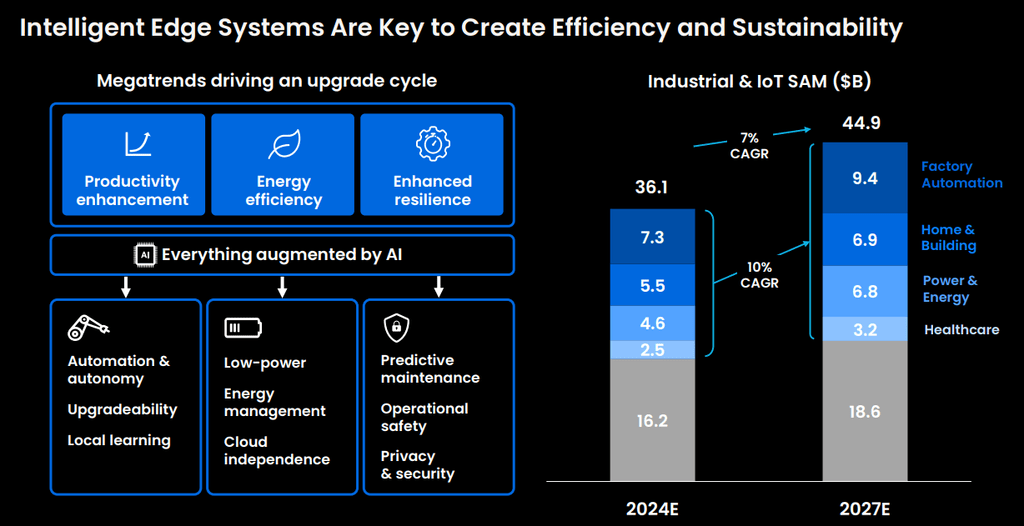
NXP: “Intelligent Edge Systems” driving semi content in all end-markets
The same principle applies in more traditional semiconductor markets. NXP derives most of its revenue from automotive and industrial end markets (with the data center end market still a small but fast growing segment for the company). Yet here too, semiconductor content is growing rapidly as all systems become more “intelligent”. In automotive, the combination of electrification and autonomous-driving capabilities is transforming vehicles into “software-defined vehicles”. For instance, an electric car contained about $1,200 of semiconductor content in 2025, roughly double the $500-600 in a combustion car, reflecting increasing requirements for power electronics, sensing, connectivity and computing. The industrial end-markets are undergoing a similar transition towards high-tech processes and products. What was once a relatively “boring” market for analogue semiconductor components is evolving towards smart factories, industrial automation, robotics and advanced sensing applications. Although this growth will seem slower compared to the hyper-growth stories from data centers alone, in our view it is a steady compounding growth story based on solid fundamentals for the long term.
Improved visibility, lower valuations
Perhaps the biggest takeaway from our trip was the current disconnect between fundamentals and share prices for the semiconductor holdings in our portfolio.
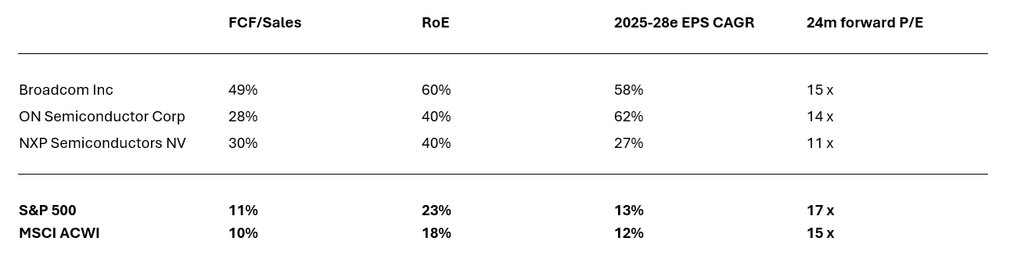
Historically, semiconductor companies have operated with limited visibility, often measured in quarters rather than years. Today, the management teams are discussing customer commitments and product roadmaps that are contracted well into 2027 and 2028. Yet despite improved visibility, semiconductor valuations in the portfolio are at historically low levels. Throughout the summer, investors focused on concerns around AI spending, peak capex and the macro environment, while largely overlooking a steady stream of strong earnings results and upward revisions to guidance. Below are some of our high conviction semi holdings, where profitability and growth are significantly better than the S&P 500 or MSCI ACWI, but yet trade at similar or cheaper levels !
Conclusion
In our view, the sector has been weighed down by recent headlines while underappreciating 3 important considerations:
- semiconductor content continues to rise across end markets;
- earnings visibility is improving;
- and valuations have become considerably more attractive.
As a result we believe this combination leaves the portfolio well-positioned for the years ahead and remain constructive on the outlook.







Xi-Trump, round two